
Have you ever wondered how to make your money work harder for you, with returns that go far beyond the usual investment options? Delinquent property taxes in Texas hold a secret to wealth—one that savvy investors are beginning to uncover. Imagine earning impressive returns while helping property owners clear their unpaid taxes. This is more than just an investment; it’s a unique opportunity with the potential for significant financial gain. With the right approach, you can turn this opportunity into a sustainable income stream, all while playing an essential role in the local community.

Ready to Get Started? Here’s What You’ll Learn
In this guide, we’ll explore everything you need to know about tax sales in Texas from delinquent property taxes, from understanding the auction process to locating properties and participating in the action. We’ll answer questions like:
Table of Contents
Let’s dive into the world of tax sale investments from delinquent properties and see why this might just be the perfect opportunity for you.

What Are Tax Sales, and How Do They Work?
Tax sales arise when property owners fall behind on their taxes. When those property taxes go unpaid for too long, counties auction off the delinquent properties to recover what’s owed. This creates an incredible opportunity for investors—because you can potentially acquire valuable properties for a fraction of their market value. Texas offers particularly appealing rates at the redeemable tax deed auction, with a 25% penalty return, which significantly exceeds what you’d earn through traditional investments.
But there’s more to it than just a great deal. By stepping into this market, you’re not only making a profit—you’re part of a system that supports local services and helps communities thrive. By ensuring delinquent taxes are paid, you’re contributing to public schools, emergency services, and community development. This dual benefit of profit and community impact is what makes tax sales such a rewarding venture.
How Do Properties End Up at Auction?
Let’s take a step back and understand how properties end up at these auctions. It all starts when property owners become delinquent on their taxes—that is, when they fail to pay on time. Counties need these funds to keep schools, emergency services, and other local infrastructure running smoothly. When the property tax bills remain unpaid for an extended period, counties decide to auction off the properties to recoup those costs. For investors, this process can be highly lucrative—if you know what to look for.
The path to auction involves several steps, including:
- Notifications to Property Owners: Property owners are notified multiple times about their delinquent taxes.
- Legal Procedures: Legal steps are taken to ensure transparency and provide the owner with ample opportunities to settle their debts.
- Auction Announcement: Once the legal process is complete, the property is listed for auction.
This transparency makes it easier for investors to assess opportunities and make informed decisions.
Penalties and Fees: The Costs and Opportunities
Investors love Texas tax sales for one key reason: the penalties. In Texas, property owners who redeem their properties have to pay a substantial penalty, which is where investors see high returns. These penalties act as a form of interest on the amount paid to acquire the delinquent tax lien, often reaching rates much higher than you could get with a bank. It’s a system that rewards patience, and one that’s designed to make it worth your while to put up the cash.
The penalty structure in Texas is unique compared to other states. Instead of earning simple interest, investors can earn a fixed penalty rate, which can be as high as 25% on the amount invested. For example, if you invest \$10,000 at the Texas tax auction and the property owner redeems anytime within a year, you would earn \$2,500 in penalties, resulting in a total return of \$12,500. This means that if the property owner redeems their property, you could earn a significant return in a relatively short period of time. The key to success here is understanding the timeline for redemption and being prepared for either outcome—whether the property is redeemed or you end up taking ownership.
Different Types of Sales: Initial Sales vs. Resales
Not all tax sales are the same. There are:
- Initial Sales: When a property first hits the auction block. These often involve more competition, as many investors are eager to secure properties with high potential value.
- Resales: If no one buys the property during the initial sale, it goes to resale – which is also known as “Over The Counter”. This can often yield even better deals, as the county just wants to recover its costs. Starting bids might be lower or in some cases, no competitive bidding is required. In Texas this list is called the “Struck Off List”.
For investors, understanding the difference between these types of sales can help in formulating a strategy that maximizes profit potential.
When and Where Do Auctions Happen?
Timing is everything—especially in the world of tax sales. Auctions typically take place on the first Tuesday of each month, providing regular opportunities to dive in. These auctions are conducted at county courthouses or sometimes even online, depending on the location. Knowing when and where these events are happening is crucial for successful participation. Staying on top of the schedule is a key part of your success as a tax sale investor.
Source: Texas State Law Library
Tips for Auction Participation:
- Stay Informed: Check county websites for auction schedules.
- Register Early: Ensure you are registered before the auction date.
- Understand Auction Rules: Each county may have slightly different procedures; familiarize yourself with these in advance.
Many counties now offer online auctions, making it easier than ever to participate without having to be physically present. This means you can bid on properties across multiple counties from the comfort of your home. Online auctions also offer the advantage of real-time updates, making the bidding process more transparent and accessible. Whether you prefer attending in person or bidding online, it’s important to be prepared and know the rules for each auction.
Finding Properties: Research is Key
Finding the right property to bid on involves thorough research. Thankfully, many counties provide online lists of properties slated for auction, making it easier than ever to browse options from the comfort of your home. You can even visit properties in person to assess their value—a crucial step for ensuring your investment pays off. The more information you gather, the better equipped you are to make a smart bid that could yield fantastic returns.

Steps to Find Properties:
- Obtain the Auction List: Access the list of properties scheduled for auction.
- Property Assessment: Investigate property details like location, condition, and market value.
- Title Search: Ensure there are no other liens or encumbrances.
- Visit the Property: View the property to assess its condition.
Online Resources:
- County Appraisal District Websites: Access property records and valuations.
- GIS Mapping Tools: View property locations and surrounding areas.
- Real Estate Platforms: Compare market values and recent sales.
By being diligent in your research, you can avoid potential pitfalls and focus on properties with the highest potential for profit.
Registering for Auctions: Your First Steps to Participation
So, you’re ready to join the action—now what? The first step is registering for the auction. This involves:
- Bidder Registration: Filling out a bidder registration form.
- Proof of Funds: In some cases, you may need to provide proof of funds.
- Receive a Bidder Number: Once registered, you’ll be given a bidder number, allowing you to participate.
It’s a simple process, but one that opens the door to incredible opportunities. Remember, preparation is key: ensure you understand the terms of each auction and the properties available so you can bid with confidence.
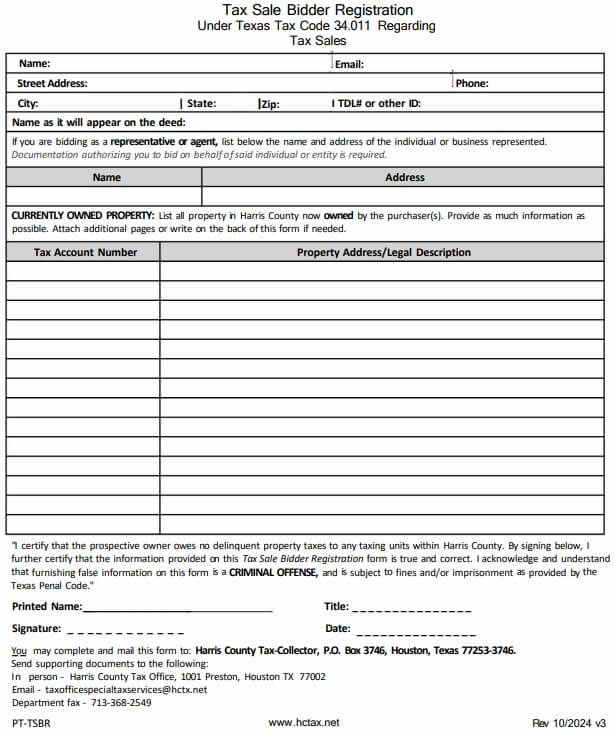
Source: Harris Bidder Registration Form
Conclusion
Now that you know the basics of Texas tax sales, it’s time to consider your next steps. These opportunities are available across the state—and they’re just waiting for investors like you to take advantage. Whether you’re looking for a high-yield investment opportunity or hoping to score a property at a bargain price, delinquent tax sales could be the perfect venture for you.
Imagine the satisfaction of turning unpaid taxes into a profitable opportunity. Tax Defaulted Property investments offer a unique combination of financial reward, community impact, and adventure. By participating in tax sales, you’re not just investing in real estate—you’re investing in your future and in the future of the community. Don’t wait—the next auction is right around the corner, and with it, the chance to make your next great investment.
If you’re ready to take the plunge, start by researching upcoming auctions in your area and getting familiar with the process. There’s no time like the present to explore the lucrative world of tax sale investments. With the right knowledge, preparation, and a bit of courage, you could be on your way to unlocking wealth through delinquent property taxes in Texas.
Frequently Asked Questions (FAQs)
What are delinquent property taxes?
Delinquent property taxes are taxes that have not been paid by the property owner by the due date. When taxes remain unpaid for a prolonged period, the property may be subject to a tax sale to recover the unpaid amount.
How can I earn money from Texas tax sales?
By purchasing tax liens at auctions, you can earn up to 25% in penalties if the property owner redeems the property. Alternatively, you could acquire ownership of the property if it is not redeemed.
What is the redemption period?
The redemption period is the time frame during which the property owner can pay back the owed taxes plus penalties to reclaim their property. In Texas, this period can vary, but during this time, investors can earn significant returns.
How do I find out about upcoming auctions?
You can find auction schedules on county websites or online auction platforms. Many auctions are held on the first Tuesday of each month.
Are all tax sales online?
Not all tax sales are online. Some auctions are held in person at county courthouses, while others are conducted online, depending on the county’s policies.
What happens if no one buys a property at an auction?
If no one buys a property during the initial auction, it goes to resale. This process is known as “Over The Counter” and in Texas specifically referred to as the “Struck Off List”. These properties often have lower starting bids and no competition, making them attractive opportunities for investors.